
The book is a heartbreaking, beautiful thing.
Thursday, January 19, 2023
Khaled Hosseini, And the Mountains Echoed
It has been years since I've posted here, and I've read dozens of great books in this time, but I have just this moment closed the back cover of *And the Mountains Echoed* by Khaled Hosseini. His *The Kite Runner* and *A Thousand Splendid Suns* are, I think, more famous, but this one is one of the most moving books I've ever read. It is heartbreaking and complicated and really, really beautiful. There is a chapter that is certainly one of the most arresting passages I've ever read in which an entire lifetime of joys and sorrows between two friends is interspersed between the counting of the 120 seconds needed to expose a negative in a pinhole camera for a photo one takes of the other.
It is almost a series of short stories rather than a single novel, but all the stories are interrelated with a single family in (and later from) Afghanistan. It jumps back and forward in time, and only lightly sketches the connections between characters and moments, so at times I would read several pages before figuring out that this chapter is from the point of view of the chauffeur who is also the brother of the mother and step-mother of the one who moved to Paris, and so on. This gives a good sense of how interwoven it all is:

Monday, June 22, 2020
Alan Moore, Jerusalem, Vol. 2 & 3
I finished Jerusalem yesterday, and having made it all the way through the three volumes (which you can also get as one giant thing), I'd definitely recommend it. There are times where my interest flagged, but it gets better and better toward the end.
The whole thing is set in the Boroughs, the neighborhood where Moore grew up, which is a blasted out working class corner of Northampton, UK. Every chapter has a different narrator, and these range from some down and out residents of the Boroughs to a group of dead children, to a demon, to a sculpture of St Michael holding a billiard cue. One chapter is a play. One is a long poem. It's a giant thing, but feels still larger, epic in scope. It's very strange. I read a lot of strange things, and this was much stranger than most.
It's really good.
Sunday, March 8, 2020
Alan Moore, Jerusalem, Book I

Alan Moore's Jerusalem, Book I: The Boroughs, is, though only a third of this massive, complete novel, a giant thing spanning many centuries, but never leaving the small English neighborhood in which it is set. There are many strange deviations from conventional reality, characters who are seen as mad by their contemporaries but who seem to be seeing what is actually happening around them. Ghosts wander old haunts, only to be occasionally seen by their new occupants.
There is a surfeit of detail, of texture, of characters and families and buildings and streets, all slowly overlapping. The pages are large, with tiny margins and small type. It is somewhat overwhelming, and you'd better not be in any particular hurry to get through it, but the writing is so consistently engaging as it switches from narrative voice to narrative voice that I was pulled along easily. I'll have to order volume II...
Christine Coulson, Metropolitan Stories
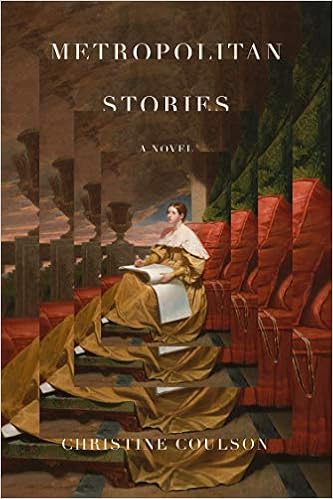
Christine Coulson's Metropolitan Stories seems a book designed for me: a novel (my favorite literary form) that is sort-of magical realist (a favorite genre) set in the Met (one of my favorite of places), inflected with a sort of new materialist thread that reminds me of Jane Bennett's Vibrant Matter (a favorite approach to art history). And it is absolutely lovely. It's quick and charming book -- I read it cover to cover between my morning tea and my afternoon coffee on a lazy Sunday.
A French armchair has a surprisingly active series of longings. A group of muses, restrained and rococo, are called upon to serve their intended role. Workmen push carts full of light. And a rather famous work turns up most unexpectedly.
I had a friend years ago who served as a night guard at the Met, and it sort of sounded like the best job in the world. The novel makes me again long for a few shifts, at least.
Monday, January 14, 2019
The Labyrinth of the Spirits
 Carlos Ruiz Zafon's The Labyrinth of the Spirits is the latest (and the last?) in his sprawling Spanish gothic Cemetery of Forgotten Books series. It has been several years since I read the previous three volumes of what I then thought was a trilogy of novels: The Shadow of the Wind, The Angel's Game, and The Prisoner of Heaven.
Like the other three installments, Labyrinth is filled with beautiful decay, crumbling palaces, manias for obscure novels, and madness. It is, though, decidedly darker than I recall the others being. Set in the period of Franco's repressive corruption, there is plenty of moral ambiguity and outright horror to go around. There are nested stories within stories, and ultimately, we are thrust backward only to learn that there has been a meta-narrative at work over all four novels. Their plots are all quite complex, and I admit I only vaguely remembered the other three, but that didn't matter a great deal. A reader could certainly start with this one, and then work backward, so that obscure details would be revealed in what would then work as prequels.
This is a book for lovers of books, for those of us who fantasize about moving to Barcelona to work in an old bookshop surrounded by the glories of fallen empires.
Friday, January 4, 2019
Sarah Perry, Melmoth

Last year, I read and very much enjoyed Sarah Perry's The Essex Serpent, which I found in one of my favorite bookshops. TES is soft and spectral and a bit wistful, even if there is a theoretical monster at its center. In both novels, Perry's writing is both beautiful and a bit precious, evocative and overly self-conscious. This seems a piece with the gothic genre, not known for restraint.
 Perry's new novel, Melmoth, is far less gentle, almost a horror tale in that it seeks to build a growing sense of dread such that the reader is looking over their shoulder as they walk down the street. It is based on a gothic ghost story of sorts from 1820, A kind of paranoia takes hold of one character after another as they become convinced (as in The Essex Serpent) that an old fairy tale is true, that Melmoth is watching every transgression, that she is there (something like the satanic narrator of Sympathy for the Devil) to watch the personal and political violences of the world, that she sees the individual failings and the epic, national failings (and Perry suggests that the latter are little more than the accumulation of the former). We roam widely, from Prague to England to Armenia to Manilla, and while the settings change, there are two constants: human failings, and Melmoth's presence, observing every one.
Saturday, October 7, 2017
Station 11, Emily St. John Mandel

It's been far too long since I put up a post here. I've read many books in the interval, but none were quite good enough to merit note. But early this semester, a student recommended Emily St. John Mandel's Station Eleven, and it is wonderful.
A pandemic has wiped put just about all the humans, and those who struggle on have to find ways to endure in the remains of civilization. No electricity, no gasoline, but plenty of decaying roadside motels to sleep in. We trace several threads that pull tighter as the novel proceeds: an aging actor who collapses on stage; a child actor handed a comic book and a beautiful paperweight; a business consultant on a flight diverted from its final destination. They all, one way or another, live by the motto written on the side of the wagon of traveling Symphony: Survival is insufficient. Each individual, each group, is pressing to do more than live.
In these troubled days, post-apocalyptic literature has a new appeal -- maybe, the book seems to suggest, after great horror, things might unexpectedly turn out to be, in strange ways, somewhat better.
Friday, October 14, 2016
The Curious Incident of the Dog in the Night-time, Mark Haddon
A few years ago, my folks and I were all in New York City at the same time. They wanted to see a play I'd heard a bit about with the unwieldy title, "The Curious Incident of the Dog in the Night-time." We were astonished. It might well be the best bit of theater I've seen. Certainly up there. It took me a while to get around to reading the novel on which it is based. I should say, the wonderful novel on which it is based.
In this book, Mark Haddon makes a sincere and sustained attempt to convey the world from the perspective of an autistic fifteen year old boy named Christopher. He is in a school for special -- that is, cognitively impaired -- students, though his academic skills are well above average. He can solve complex math problems, but needs a set of flashcards with emojis on them so that he will know how to interpret facial expressions. He seems, in a way, to be a highly caring person, though without an understanding of the common cues most people use to navigate interpersonal relationships.
Christopher finds his neighbor's dog murdered, and engages in some amateur sleuthing, uncovering family secrets, betrayals, an untapped reserves of strength and courage.
Friday, January 15, 2016
Alison Kinney, Hood
Last semester, I taught a new course on Monster Movies. This was, of course, tremendous fun, but it was also serious work. We watched so many wonderful films, read great essays about them, and had lively conversations each week. One of the leitmotifs of the course was "People are the worst." This was not really where I'd anticipated taking the course. We had vampires and zombies and artificially constructed horrors, but time and again, week after week, we found ourselves concluding that however bad the demons/dragons/revenants/Evil Dead were, it was the humans who really, really were just the worst.
The overarching narrative of course crystalized on the day that we discussed George Romero's 1968 classic Night of the Living Dead, the film that reinvented the zombie and became the source for more or less all subsequent zombie narratives. It is a brilliant film. Really. If you don't believe me, you haven't seen it. Get a copy. You need to see this film. The last few minutes transform all that has come before, and it is all suddenly (according to Romero, unintentionally) a parable about the ways that we divide ourselves from one another, and in particular the ways that race, or racial thought, leads to wanton waste of life.
There isn't a hood within it, not that I recall anyway, and yet I kept thinking of it as I read Alison Kinney's phenomenal new book, Hood, in Bloomsbury's innovative Object Lessons series. Each book in the series focuses on a single object type -- Shipping Container, Cigarette Lighter, Bookshelf. Hoods might seem the most innocuous of subjects, just nice bits of fabric to keep off the rain or the wind, but as Kinney traces their history from the Middle Ages forward, it becomes increasingly clear that this simple object is embedded in some of the most potent cultural currents. The book is small and slim, beautifully produced and a pleasure to hold. The writing is likewise beautiful, but the content is hard, harsh, startling, and necessary.
Kinney starts with the hoods we all think were worn by executioners, but reveals that this is a modern fiction, that it was the executed who more often were (and are) made to wear the hood. Nineteenth-century writers reveal the reason: the condemned must wear a hood in order to protect "the witnesses, even the executioner himself ... the most vulnerable people at an execution, while the prisoner was a kind of Grim Reaper, even at the moment of his own death" (19). If you are tempted to argue that people being executed deserve what they get, read this book's accounts of lynchings of men, women (including a gut-wrenching account of the lynching of a pregnant woman), and, yes, children. The revelation of a process of inversion of blame, where the victim becomes the threat and his murderers become the endangered, runs throughout the book, and is one of many disturbing realities it reveals. This hoodwinking is a key part of what Kinney calls "[t]he minstrelsy of victimhood," a brilliant phrase I will be borrowing (with citation) for in my current book (50).
Hood did something I wouldn't have thought possible: it made me realize that the Ku Klux Klan, which the Southern Poverty Law Center calls "the most infamous — and oldest — of American hate groups" is worse than I thought it was. How could they be any worse? Read the book. They are even worse. The hoods are just the start.
Ben, the African-American protagonist of Night of the Living Dead, does not wear a hoodie. He dresses "just right." He is a preppy, Joe College type, wearing a cardigan through much of the film, even while driving a tire iron through the forehead of a zombie. He seems at pains to demonstrate that he is a good guy (even if, in a cathartic moment, he slugs the middle-aged white guy).
I thought of this film at several points in my reading, but it seems most relevant toward the end. We all know, from the very image on the cover, where it is all tilting. He is mentioned in passing on page 98 but discussion of this most prominent case doesn't really happen until page 108. Indeed, when he is first introduced, Kinney is coy about it, knowing that we all know the name. She writes:
On a drizzly evening, February 26, 2012, one teenager in a hoddie tried to make himself invisible, to keep his head down in a dangerous environment. 'That man's following me,' he told his friend over the phone. 'I'm going to run.' He never made it home."He" is, of course, Trayvon Martin, the Black boy shot and murdered by George Zimmerman, an overzealous, self-appointed, apparently paranoiac, violence-seeking "neighborhood watch" member who was acquitted, in part, because the boy he shot was wearing a hood.
What follows is a sorrowful, infuriating litany of names that runs for a couple of pages:
Trayvon shouldn't have been one of the countless people wearing hoodies on that rainy night ... Michael Brown shouldn't have walked in the street. Nicholas Heyward (thirteen years old) and Tamir Rice (twelve) shouldn't have been playing ... Jonathan Ferrell and Renisha McBride shouldn't have needed help after car accidents ... (111-112)The list culminates a page later with, "Eric Garner shouldn't have stopped breathing" (113). These "errors" at first feel increasingly arbitrary, but they are not. They are all equally so. Wearing a hooding or walking in the street is, yes, a more conscious and deliberate act than stopping breathing, but they are not reasons to die, and not, despite court rulings that demonstrate no regard for Black lives, justifications for murder.
The key is that it wasn't the hood. It was never the hood. The hood tells us nothing about Martin, and everything about Zimmerman, his defenders, the jury, the media. "The rhetorical uses of Martin's hoodie," Kinney writes, "revealed not his attributes, but those of the people who committed, rationalized, and exonerated the shooting of an unarmed teenager walking home" (109). Like the hooded prisoners being executed, this hooded boy was seen as somehow causing his own death by wearing a sweatshirt. Through the magic of the hood, victim is turned into the perpetrator, and the murderer becomes a victim. And we are all hoodwinked.
Sunday, October 25, 2015
Paul Kingsnorth, The Wake
Paul Kingsnorth's The Wake is among the strangest, darkest, most beautiful, novels I've read in some time. It was written with crowdfunding, which is perhaps one of the new routes to artistic patronage. It then went on to be shortlisted of several book prizes, and then got picked up by a mass market publisher. This might be an usual route for a novel now, but in a few years will probably be pretty common.
The story centers on Buccmaster, a minor Anglo-Saxon landowner living through the devastation of the Norman Conquest of 1066. However, this is no ordinary piece of historical fiction. Much of the power comes from the strange language in which it is written, an amalgam of Old English and Modern English. While some of my Anglo-Saxonist colleagues were bothered by its lack of historical accuracy, or better, historical specificity, I wasn't in the least troubled, and I strongly doubt that any reader not a specialist in the history of the English language would be.
The strangeness of the language, which is clearly neither Old nor Modern English, creates an atmosphere, a mood and, most powerfully, a personality for the narrator. He is a disturbing character in many ways, and the brooding, menacing tone of the novel was, for me, highly effective, especially at the outset and again toward the end. The evocation of the loss to the Normans is powerful, and made more complex because we largely experience it through a character that, for me, was decreasingly sympathetic. Also, the description of the landscape and the human connection thereto is a great strength of the novel, and it was unsurprising to find (impressive research, since it is mentioned on the back cover) that Kingsnorth was editor of Ecologist magazine. There rich descriptions of the fens -- the boggy wetlands of England, are striking and beautiful.
Buccmaster is in dire straits. His wife is dead, his town is burned to the ground by the "ingengas," the in-comers, the French. A passage wherein he thinks about the names of the trees captures much of his crisis. Read it aloud and you'll catch more of the meaning:
now in this small holt [forest] by bastune locan at the treows i was thincan that these frenc they woulde gif all these things other names. i was locan at an ac treow and i put my hand on its great stocc and i was thincan the ingengas will haf another name of this treow, it had seemed to me that this treow was anglisc as the ground it is grown from anglisc as we who is grown also from that ground. but if the frenc cums and tacs this land and gifs these treows sum frenc name they will not be the same treows no mor.When an English oak tree is known by a French name, he is saying, it won't be the same tree any more. The writing is so strange and alien that it takes 20 or 30 pages to get the hang of it, but once I got it, I fell deep into the meres and fens and woods and murk of this moment of cataclysm.
Sunday, May 31, 2015
Edgar Lee Masters, Spoon River Anthology
As you might have found, I have a penchant for picking up books abandoned in cafes, especially if they seem to be written by lunatics. My latest such find was, I am surprised to say, rather brilliant. Edgar Lee Masters's Spoon River Anthology, first published in 1915 is a dark and blunt assessment of the inner life of a small town. This book is a collection of short poems in the voices of the dead, lying side by side in the town cemetery, giving voice to their sorrows, jealousies, regrets, and, occasionally, joys, most of which are deeply lodged in their life on earth rather than there unclear place in an ill-defined afterlife.
The cemetery holds rich and poor, powerful and outcast, bankers, publishers, poets, prostitutes, drunks, thieves, and a few murdered, all lying in repose beneath its old trees. Each of the graves is marked with a monument, many of which were carved by the aptly named Richard Bone. His jaundiced view arrives about half-way through the collection, by which time its message has already become clear:
When I first came to Spoon River
I did not know whether what they told me
Was true or false.
They would bring me the epitath
And stand around the shop while I worked
And say "He was so kind," "He was so wonderful,"
"She was the sweetest woman," "He was a consistent Christian."
And I chiseled for them whatever they wished,
All in ignorance of the truth.
But later, as I lived among the people here,
I knew how near to the life
Were the epitaths that were ordered for them as they died.
But still I chiseled whatever they paid me to chisel
And made myself party to the false chronicles
Of the stones,
Even as the historian does who writes
Without knowing the truth,
Or because he is influenced to hide it.
I don't read much poetry written after the thirteenth century. I have little tolerance for nostalgic tones or soft focus. This collection has neither, just hard-hitting, bald truths, and the odd moment of brilliant light. Part of the fascination comes from piecing the stories together -- a husband thinking fondly of his loving wife might be followed a few pages later by the same wife, speaking with love and lust of another man. A murder and his victim provide two sides of the same event. Beloved and respected figures admit their hypocrisies, now that they are dead and mute.
A convenient online edition links the gossiping characters to one another. This was all quite shocking in 1915, when the myth of the happy small town was quite robust. It is still a mainstay of political speeches, though thanks to Masters -- and 100 years of history -- we know better, now.
Friday, May 8, 2015
Jack Black, You Can't Win
"If you live with wolves, you will learn how to howl."
Jack Black spent the better part of the first two decades of the Twentieth Century in prison, on the run, riding the rails in boxcars, robbing homes and businesses, sleeping beneath bridges, frequenting gambling houses, befriending hookers, and keeping his word. After receiving surprising leniency from a prosecutor and judge, Black gave up the life, settled down, and wrote this memoir, which is more gritty and true than all the hard-boiled detective stories and gangster tales that seek to recreate the world in which he lived and, several times, nearly died.
Black is an unrepentant criminal, and walks the reader through his schemes. I learned a great deal about how to rob safes from small towns, though only if it is 1915. I also, though, learned a great deal about prisons and about the brutality of police and corrections officers, and this information seems depressingly relevant. It seems that I can't open the news without being greeted by a tale of police violence or another of the horrors of incarceration. Black is flogged in one of his several stints in prison, but the focus is not on the act itself. Instead, he pivots immediately to the effect it had on him:
I don't know to this day whether the law contemplates flogging as a punishment as a deterrent, or partly both. As a punishment it's a success; as a deterrent it's a failure ... The flogging just hardened me more, that's all. I found myself somewhat more determined, more confident, and with a feeling that I would play this game of violence to the finish. I had taken everything they had in the way of violence and could take it again. Instead of going away in fear, I found my fears removed ... I got up and went my way with the thought that I had got more out of that prison and its keepers than they had got out of me.It takes, instead, an act of generosity to drive Black out of his career in crime, a bit of surprising faith in him by a state system that seemed hellbent on his destruction:
I wish I could sift out a few grains of wisdom from my life that would help people to help prisoners, and help prisoners to help themselves, but I can't find them. I don't know. All I can say with certainty is that kindness begets kindness, and cruelty begets cruelty. You can make your choice and reap as you sow.The surprise of the book is how likable Black is throughout. He is not self-aggrandizing or melodramatic, like so many fictional versions of such lowlife characters and denizens of underworlds. He comes across as honest, direct, and a sharp observer of human nature. This coming year, our campus book in common will be Just Mercy: A Story of Justice and Redemption
 . I think we might have chosen this hundred-year old book, instead, since it not only brings many of the same issues to the surface, but because it also shows us how old and intractable these problems are.
Tuesday, December 9, 2014
James Baldwin, Another Country
There are many possible "other countries" throughout James Baldwin's novel, set in New York in the early 1960s (when it was written). There are actual other countries -- two characters are in Greece when we meet them, and one of them is French -- but more salient are the separate worlds, packed densely into that most remarkable, most wonderful and terrible city in the US: New York. The characters living in bohemian squalor in the Village are a world away from those struggling to get by uptown in Harlem (a few blocks from where I sit, writing this. Only in the end does it seem that the other country of the title is actually *love.*
This is a searing novel, occasionally melodramatic, yes, but on the whole, gutting, blistering. The characters are all trying so hard, trying desperately to defy what they have learned about cultures, groups, genders, races, sexualities. 'White' and 'Black,' 'gay' and 'straight,' married and single, the interwoven characters are all cheating , lying, and clinging to those they need, all while constantly driving knives into those who most want to help them.
In one brief moment of successful -- albeit stolen, fleeting, and doubly adulterous -- passion, one character turns to another to say:
This day is almost over. How long will it be before such a day comes for us again? … I can't really like from moment to moment, day to day, month to month, make you less lonely. Or you, me. We aren't driven in the same directions and I can't help that, any more that you can. … And if we tried to arrange it, prolong it, control it, if we tried to take more than what we've -- by some miracle, some miracle, I swear -- stumbled on, then I'd just become a parasite and we'd both shrivel.
This, it seems, is as good as can be hoped for: an hour of true companionship, before everything spirals away again, out of control, to the wild Jazz beats that punctuate their lives.
Tuesday, September 30, 2014
Kevin Wilson, The Family Fang
Kevin Wilson, The Family Fang
Caleb and Camille Fang reject conventional art — paintings, sculptures, photography, and so on — and even traditional art “happenings,” in which artists create events. They prefer a sort of guerrilla art in which the artists create chaos and watch its effect on the unsuspecting public. A mess to the public. Beauty to the artists.
Disaster to Child A and Child B, the Fangs’ children. This wonderful novel alternates between the extraordinary art events concocted by the Fangs when their children were young, and the challenges they face trying to exist in the world as adults. The novel is darkly funny, very strange (and possibly somewhat anti-art, but no mind). It is apparently being made into a Hollywood movie now, but ignore that. It won’t be as good. Get the book, instead.
Wednesday, June 4, 2014
Nicholas Lamar Soutter, The Water Thief
Nicholas Lamar Soutter, The Water Thief
I have no idea how I came into possession of this novel. I found it on my shelf, with no receipt to indicate purchase, no penciled price on the flyleaf to suggest a used book store, and it seems to have no publisher, so presumably was self-published by the author. It did win the Kirkus Star, a presumably distinguished literary award I've never heard of.
The novel is a future dystopia, set in a time when the corporations have truly taken over the world, such that everything and everyone is their property, and profit is the only acceptable and moral motive. Self-interest is the highest good. In essence, it is as if every worse-case scenario of a liberal's nightmare vision of a corporate future has come to be. It seems to be a book written to counter the horrors of Ayn Rand (the luxury neighborhood is called "The Galt"), and Soutter's prose are regrettably no smoother than her tortured attempts at writing. Our hero is a midlevel office drone for the Ackerman Brothers corporation, which is among the stronger players in a world where the "social contract" has been thoroughly rejected. He has been a more or less happy drone for years, when I reads a story about a woman who objects to the capitalist system, where those who interfere with profits are rendered to make soap, in order that the corporations can recoup some of their losses. He is a naive, recent convert to the notion of socialism, and his ruminations often read like late-night freshman bull-sessions:
Competition exists in facets of life, but that doesn't make it the sum of life. You can see the world through rose-colored glasses, but that does not make the world rouge, even if you live a lifetime that way. Violence is the only possible conclusion to capitalism.Would I recommend this one? If you have one of those annoying friends who is always going on about Rand (or any of the more current libertarians who follow her), who keeps trying to get you to read Atlas Shrugged, then buy a copy of this for him for his next birthday.
Saturday, February 22, 2014
China Mieville, King Rat, The City & the City, Perdido Street Station
In the last few months, I read three novels by China Miéville: King Rat, Perdido Street Station, and The City & The City. I'd been hearing for ages that I'd love his writing (from people who were absolutely correct), so when a friend suggested we have a book club and start with King Rat, I jumped on it. All three are fantasy, though one is contemporary urban fantasy, another Steampunk, and the third is set in a sort-of parallel world. They differ in style, tone, and setting, but all are compelling, consistently creative, and somewhat creepy. But what really tied them together for me was a focus on vision -- on what we see and what we don't, or won't.
King Rat is set in London, roughly when it was published (1998), but primarily in the sewers and slums. I was startled when I realized that the decayed and dangerous neighborhood south of the Thames, where much of the action occurs, was the same now-trendy, upscale neighborhood where I'd just spent a few weeks. Prince Harry apparently hangs out at one of the local bars, regularly (though this, of course, does not improve the area). The book sets two age-old enemies against one another: King Rat (who asserts that he is a rat, and lives and eats like one, though he is human is shape) and the greatest of all rat catchers, the Pied Piper of Hamelin. Along the way, we meet Anansi the Spider King (similarly, at once a spider and human) and the Bird King Loplop (borrowed from the art of Max Ernst, of all places). The main character, Saul, learns of his rat heritage and, without changing his appearance, accepts his linage and becomes a rat. Outer appearance is not inner ontology. A whole parallel world opens before him, complete with alternate codes of conduct and Other moralities.

The City & The City, for me the most interesting of the three, also centers on parallel worlds. Here, two cities coexist in space and time -- they are superimposed on top of one another, as if each were the other's palimpsest. Set in an unnamed Eastern European country, in our own present world, these parallel cities draw attention to the ways that different groups can live side-by-side without ever acknowledging one another's existence, though they are both defined and granted meaning by their ever-unseen Other. The plot unfolds as a police procedural, but, gripping though this element is, the main issue here is the fracture, the gap that divides a city from itself.
Finally, Perdido Street Station is something of a sprawling genre exercise in Steampunk fantasy -- everything hisses and pops, with boiler-powered robots, hybrid creatures, and the stench of a retro-futuristic London-esque city. There is great fun in the inventiveness, even if, in the end, the plot seems to get a bit away from Miéville. The cactus-people in their giant greenhouse dome, the interspecial love affair between a bug-woman and a human man, the Remades punished for legal transgressions via horrifying reconstructive surgeries, all create a fascinating atmosphere that is, like the cities of The City & The City, really the protagonist of the novel. They are all at risk of being captured by the hypnotic, terrible beauty of giant, carnivorous moths that bring into question the role of vision, and the horror of beauty.
Read all three. For me, onward to The Scar!
Wednesday, December 4, 2013
Book Sale!
Blog readers! James Kuiper is selling off much of his excellent library. Go and get some books! I'll certainly be there, buying novels....

Sunday, September 29, 2013
Colson Whitehead, Zone One
Zombie narratives tend to fall into two camps: depressing and ironically funny. Some are both. Colson Whitehead's Zone One is both, at times, but it is also beautiful and rich and occasionally profound.
Zombies tend to be fairly transparent metaphors -- they began as the enslaved workers of Haitian sugar plantations, but then came to be stand-ins for any and all disempowered worked drones. For Whitehead, though, they reflect all of us. There are two varieties of "skels" to be fought: the active, hungering type, lumbering around and tearing off hunks of the flesh of the temporarily-still-living; and the "stragglers," who are frozen in a moment, arrested in inscrutable trances. They stand at copy machines, or gaze blankly at shuttered boutique windows, as apparently oblivious to the ruin within the shops and to the ruin within themselves:
Why this particular juice joint and not another, why this neighborhood greasy spoon, synagogue, bookstore, 99 cent store? … The window-shopper bewitched before a boarded up department-store window, taking in a long-removed display that nonetheless unfurled its exquisitely arranged baubles behind the plywood.
The protagonist, ironically dubbed "Mark Spitz," after the great Olympic Swimmer, reflects on the stragglers:
They were safe in their houses. In front of the televisions, of course, a host of this type biding their time until the electricity came back on, the problem was solved, and the program resumed where it had stopped. All the time in the world. Their lives had been an interminable loop of repeated gestures; now their existences were winnowed to this discrete and eternal moment...And later, on the plague's impact on his own emotional state:
The world stalled out at his edges. Sometimes he had trouble speaking to other people, rummaging for language, and it seemed to him that an invisible layer divided him from the rest of the world, a membrane of emotional surface tension. He was not alone. 'Survivors are slow or incapable of forming new attachments,' or so the latest diagnosis droned, although a cynic might identify this as a feature of modern life merely intensified or fine-tuned with the introduction of the plague.
"Mark Spitz" succeeds in this impossible situation. He is a survivor not because he is exceptional -- he isn't -- not because is he particularly brave or strong or smart or noble. He succeeds because the zombie plague reduces everyone to total mediocrity. The skels staggering around are pathetic. They are weak and slow and dumb, only dangerous because they are so infectious and so very, very numerous.
There are moments of gore, but they are not the point. This is not disaster-porn, not horror for the sake of conjuring disgust and revulsion. It is a cerebral novel, with a great deal to say about us and our condition.
Thursday, September 19, 2013
William Gibson, Neuromancer
Over the summer, I was sitting on the roof of a friend's apartment in Jersey City, chatting about novels as the sun set, and he recommend Neuromancer by William Gibson (thanks Josh). It had been ages -- years and years -- since I read some good, straight-up sci-fi. This genre was a staple of my teen years (Last week, I was surprised to see that there is a new film coming out of Ender's Game, which was my favorite sic-fi novel at the time, staring a kid named Asa!).
Neuromancer was published in that greatest of science fiction years, 1984, and it depicts a dystopic future in which the rich live lives apart from the rest of society, encapsulated in bubbles of pleasure, and the rest live in squalor, in which everyone is connected by a computer network, and hackers are the elite of the criminal class, in which computer viruses made in China are used by criminals to hack into the world of the rich. Sound familiar? What was certainly wild fantasy and speculation thirty years ago is, well, the world we live in. Ok, I exaggerate. The rich don't live on space stations, so this world is nothing like ours.
The main character is a fairly unlikeable down-and-out everyman named Case, a former master hacker whose nervous system was altered by an angry former associate in order to stop him from being able to plug himself directly into the Matrix. Case is hired (somewhat coercively) by a shady individual who wants him to pull off an impossible hack, with the help of a biotechnologically augmented samurai with razor claws named, surprisingly, Molly. They are also helped by a ROM of Case's old mentor, now dead but kept conscious within a computer.
There is a bit of sex and a lot of drugs, but the most compelling passages are the descriptions of Case's work within the Matrix, a sort-of immersive visualization of the codes within computers. No, not like Neo and his pals, not really, though certainly the Wachowski Brothers must had been influenced by Neuromancer. Gibson gives us beautiful descriptions of the architecture of the virus, as it merges with its host, and Case's movements as he soars through it. There is, even in their pain and panic and in the general breakdown of society, beauty.
Saturday, September 7, 2013
Edward Docx, The Calligrapher
The Calligrapher, by the seemingly pseudonymous "Edward Docx," is a book I don't think I'd have picked up in a shop, since -- like all of us -- I judge books by their covers. This one has the look of a literary romance, with the pen, the bed, and the pairs of shoes. Hardly my style. No monsters, no grim settings, no apparent darkness at all. But the book was recommended (and given) by a friend whose taste is impeccable, so I gave it a try.
It is brilliant. And there are monsters. They are just shaped like beautiful people.
The novel is centered on Jasper Jackson, a talented calligrapher and therefore a living anachronism. He was raised by his grandmother, who is a scholar of medieval manuscripts, and as a child he was punished by being made to copy out Latin texts in various formal scripts. He has grown into a rather finicky playboy. Perhaps as a result of his careful study of the painstaking art of calligraphy -- an art form with very little tolerance for error -- he has become a perfectionist in many quarters of his life. There is a proper way to make a cup of tea (loose leaves, never bags), of coffee (espresso only), a proper way to prepare a dinner, and, most importantly, a proper way to carry on multiple affairs, while deluding one's loving, faithful girlfriend.
Jasper excels at all of these things. He is something of a professional. Until he slips, and makes the grandest of rookie mistakes: he falls in love.
Throughout the novel, Jasper is working on a private commission of the love poems of John Donne, and each chapter takes its title and framing structure from one of Donne's complex, fraught poems of love. This might have been merely a clever trick, but Docx turns many of these poems into rich points of contemplation, poignant reflection, and, increasingly, menace, sorrow, and loss.
The Calligrapher is bitingly funny, compelling, and beautiful. And damn, I didn't see that ending coming. Well worth the read. And thank you, Suzanne!
Subscribe to:
Posts (Atom)